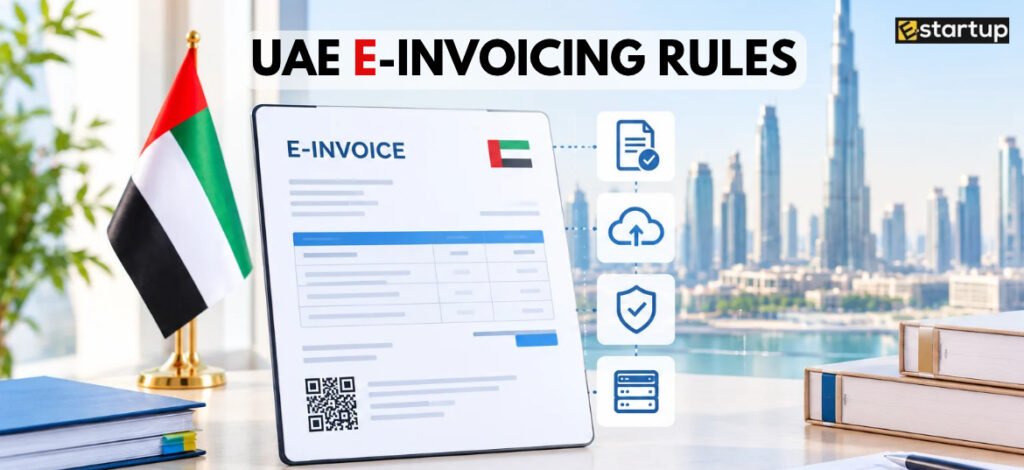
UAE E-Invoicing for Small Businesses is an important topic for startups, entrepreneurs, and small and medium-sized enterprises preparing for the UAE’s new electronic invoicing system. These rules will change how businesses issue, exchange, and report invoices for eligible transactions. Understanding the requirements, implementation deadlines, and preparation steps can help businesses get ready for compliance.
It is very necessary to comprehend the UAE E-Invoicing Regulations for Small Business, which is needed for individuals wanting to manage their invoices efficiently. Individuals include startups, small and medium enterprises, and entrepreneurs.
What Is the UAE E-Invoicing System?
This UAE e-invoicing system is a digital platform that allows the creation and dissemination of the structured data in the invoice. This platform has been created in order to automate the process and make transactions accurate and transparent.
It needs to be mentioned that delivery of an invoice in the PDF format via email cannot be considered an e-invoice in accordance with the new rules. An e-invoice includes the structured data that can be processed electronically.
The platform operates on the basis of the Peppol model adopted in the UAE.
Why Is E-Invoicing Being Introduced?
The system aims to:
- Reduce manual invoicing and mistakes in data entry.
- Increase accuracy in accounting.
- Help with efficient tax filing.
- Increase standardization in the process of invoicing transactions between companies.
- Foster increased transparency and compliance in business transactions.
These developments present a chance for small business owners to update their accounting procedures in preparation for compliance requirements.
UAE E-Invoicing Requirements for Small Businesses
E-Invoicing in the United Arab Emirates covers business-to-business (B2B) and business-to-government (B2G) transactions with some exemptions. Whether or not a company has to follow this law depends on the laws as well as phases of implementation. Below are the criteria that small businesses should know.
1. Check Whether Your Business Is in Scope
Begin by recognizing what kinds of transactions take place in your organization. If your business has the regular activity of invoicing another business or governmental body, you should take a look at what the guidelines mean for your operations.
It would be wrong to assume that your organization does not have to follow the guidelines simply because it is a small operation run by a small number of people out of a small office and sends out fewer invoices than others.
2. Prepare to Use an Accredited Service Provider
These companies have to abide by the procedure in this system when it comes to onboarding and then recruit an Accredited Service Provider (ASP).
This will ensure that structured invoice data is transferred and reported. Some of the issues that you need to look at when choosing one include accreditation, compatibility with your accounting software, cost, and others.
3. Organise Your Invoice Data
It is very important to have correct information in invoices. Check all the data your company keeps about customers, suppliers, products, services, etc.
Your preparation checklist should include:
- Proper details for customers and suppliers.
- Uniform invoice number and transactions.
- Calculation of the correct amount and VAT, if applicable.
- Correct details for your invoices and credit notes.
- Details that can be imported to your chosen software.
The specific mandatory fields vary based on the technical specifications and type of transaction; therefore, organizations must refer to the guidelines for UAE e-invoicing.
4. Review Your Accounting Software
Invoicing systems that you use presently might not be able to support the structure for exchange of data in the new framework. Inquire with the software vendor about the possibility of integration with a certified service provider.
Avoid buying another system until you determine whether the old system can be customized.
UAE E-Invoicing Implementation Timeline
The UAE is introducing e-invoicing in phases. As of 28 October 2026, the key dates for businesses are as follows.
| Business Category | Deadline to Appoint an ASP | Mandatory Implementation |
| Annual revenue of AED 50 million or more | 30 October 2026 | 1 January 2027 |
| Annual revenue below AED 50 million | 31 March 2027 | 1 July 2027 |
These dates correspond to the revised timeline published by the officials. Companies need to check their classification as well as any exemptions that apply to them.
What is the Implication for Small Businesses?
The compliance deadline for firms that earn less than AED 50 million annually would be 1 July 2027, while ASP nomination would take place on 31 March 2027.
However, this does not imply that firms have to begin their process from 31 March 2027, because the whole process could be put on hold as a result of software installation, data cleansing, selecting providers, training of staff, and testing.
Also, voluntary implementation is possible starting from 1 July 2026, depending on the system’s technical requirements. Those who consider implementing the new system earlier need to check whether it is reasonable.
Preparations for Compliance of Small Businesses with UAE E-Invoices
This may help small companies manage the transition without disrupting their regular invoicing and collection activities.
Step 1: Review Your Current Invoicing Process
Identify the procedure through which your firm prepares, distributes, receives and follows up on the invoices. Identify whether your firm is using Excel spreadsheets, accounting systems, manual invoicing systems, or all of them together.
This will enable you to identify the gaps between your procedures and the ones you need to have.
Step 2: Select a Suitable Accredited Service Provider
Compare available providers based on:
- UAE accreditation.
- Compatibility with your current accounting software.
- Cost of installation and subscription.
- Security of information and support.
- Capacity to process your number of invoices.
Check the latest official list of approved providers through the UAE Ministry of Finance e-invoicing portal.
Step 3: Clean Up Business and Customer Records
Improperly recorded data may cause some issues during system integration. Check the customer, supplier, tax, and invoice information prior to data migration.
Where applicable, consult your accountant or tax advisor to verify that your financial information is accurate.
Step 4: Test the New System
Before the mandatory enforcement, it is imperative that you collaborate with your service provider in testing the generation, transmission, receipt, and generation of credit notes of invoices.
It is also imperative that you test rejection of invoices, data entry errors, system disruptions, and handling of errors.
Step 5: Educate Your Employees
Invoicing, accounts receivable, accounts payable, and bookkeeping staff need to be informed about this change.
These policies can be developed internally regarding such issues as approval of invoices, data entry, correcting mistakes, documentation, and so forth.
Typical E-Invoice Errors Made by Small Firms
Businesses can reduce implementation problems by avoiding these common mistakes.
- Assuming that PDF is good enough: Normal PDF, invoices scanned and sent by email cannot be considered as structured e-invoices because it is a digital document.
- Procrastinating: Putting everything till the very last minute can lead to lack of time for testing and implementation of the software.
- Making a decision solely on the basis of its cost: The cheaper solution will have certain missing elements.
- Disregarding data accuracy: Incorrect customer information or incorrect tax rates may affect e-invoice processing.
- Not accounting for the credit notes: It is necessary to know how to deal with correction of the errors according to the new process.
- No updates tracking: Companies need to be aware of updates issued by the authorities.
How E-Invoicing Can Benefit Small Businesses in the UAE
While implementation does necessitate planning, a successful electronic invoice process can bring numerous advantages to operations.
Faster Invoice Processing
Structured data helps in minimizing human intervention and manual processing, making it easy for businesses to manage their invoices efficiently.
Better Financial Visibility
Digital records that are kept consistently will enable you to have an easy time tracking the outstanding invoices and their payments.
Improved Record Accuracy
Automated information transfer can reduce errors that may be committed due to the manual transfer of information between systems; however, organizations must make sure that their due diligence is still in order.
Easier Business Scaling
Invoicing can be effectively managed through integration, and thus the increased transactions will not translate to an equal amount of administrative work done manually.
This is based on how effective the integration is done and also the capacity of the provider used.
Conclusion: Prepare Your Business for UAE E-Invoicing
The emergence of the e-invoicing system in the UAE is an important step for all companies regarding invoice data and finance transaction management. In case of small companies, preparation beforehand might be helpful to avoid any trouble in the final stage.
Understand the UAE E-Invoicing for Small Businesses requirements, confirm the applicable deadlines, review your accounting system, and select a suitable accredited service provider determine which deadline applies to your company, analyze your accounting system, and select a provider and try the system beforehand.
Need assistance in getting ready for regulatory changes for your UAE business? E-Startup will help you understand the rules of business compliance and find the right business support for you. Visit E-Startup UAE to learn about its business setup services.
Disclaimer : The article gives general information only. For the latest requirements, deadlines, and exemptions from regulations, please check with the UAE Ministry of Finance or Federal Tax Authority.
Frequently Asked Questions
1. Is e-invoicing mandatory for small businesses in the UAE?
Phase-wise mandatory implementation of e-invoicing is being implemented in UAE. Enterprises having income less than AED 50 million annually have an implementation date of 1st July 2027, while the deadline for ASP is 31st March 2027.
2. Is a PDF invoice considered a UAE e-invoice?
Answer: No. Under the new system, a PDF, scanned image, Word file, or email attachment is not an e-invoice in structure form. The invoice information should comply with the electronic process of the system.
3. Do small businesses need an accredited service provider?
The organizations that are obliged to follow the UAE e-invoicing system must abide by the service-provider requirements related to this matter. It is essential for the organization to review the updated list of accredited providers and choose one.
4. How can a small business get ready to use e-invoices?
First of all, you should examine your present billing procedure to see whether it comes within the scope, check your accounting system, and clean up your client and vendor files. After that, it is time for evaluating your accredited vendors.