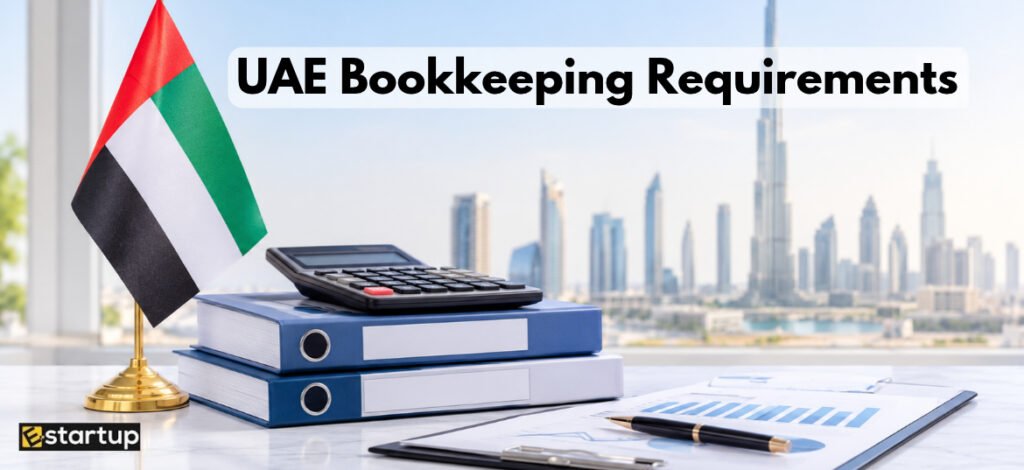
Running a business in the UAE is not just about customers and sales. Business people need to keep proper financial records so that they would know how well their business is doing and comply with all relevant laws and taxes.
It is important to be aware of the Bookkeeping Requirements in UAE for any start-ups, entrepreneurs, and small business people. Effective bookkeeping will help businesses to keep track of income and expenses, prepare financial statements, fulfill VAT requirements, and keep corporate tax documents.
No matter whether your business is a mainland company or a free zone one, keeping organized accounting records will help you avoid all kinds of mistakes and financial problems. The information below will clarify what the basic bookkeeping requirements are and which documents should be kept.
1. What Is Bookkeeping and Why Is It Important in the UAE?
Bookkeeping is the process of recording all the financial activities of the firm through accounting. This includes recording sales, purchases, expenses, payments, collections, and other financial activities.
In the case of UAE-based businesses, bookkeeping is vital in terms of ensuring transparency and adherence to laws related to business and taxation.
The following are some of its advantages:
- Financial planning: You need to know your income, expenditure, and profit.
- Tax: You should have all the required documents regarding VAT and corporation tax.
- Financial Record Keeping: Maintaining accurate financial record books.
- Effective Financial Management: You have to be able to effectively manage all your money inflows and outflows.
- Financial audit: You should have your financial records organized for an audit.
- Business planning: Make good use of your financial information in decision-making.
According to the Commercial Companies Law in the United Arab Emirates, there should be accounting records that clearly indicate the financial status of the firm.
2. UAE Bookkeeping Rules for Small Businesses
Despite the small size of an enterprise, it has to comply with all the applicable accounting and record-keeping standards. They can vary depending on the business structure, type of activities and tax registration.
Basic UAE bookkeeping principles include:
Maintain Accurate Accounting Records
All business transactions must be recorded in an organized manner. The records should reflect the financial standing of the company at any particular point in time.
Some of the important records are:
- Sales and purchases
- Business revenue and expenses
- Bank statements and payments
- Payables and receivables
- Wages and personnel expenses
- Inventory and stocks
- Assets and liabilities
Prepare Financial Statements
Businesses are supposed to retain financial information that will help in preparing the financial statements, which include:
- Balance sheet
- Profit & loss account
- Statement of cash flow
The financial statements must be prepared in accordance with the relevant accounting principles.
Keep Supporting Documents
Each financial transaction must be supported with all the necessary documents such as invoices, receipts, contracts, bank statements, and proof of the payment.
These serve as evidence for the validity of the financial transaction.
3. What Accounting Records Must UAE Small Businesses Maintain?
Accounting Records in UAE will help the firms to keep track of their financial transactions. The following are the primary accounting documents for small businesses.
1. Sales and Purchase Invoices
It is important to keep records of invoices that are sent to customers and those that are received from suppliers. The VAT-registered companies should ensure their invoices comply with FTA regulations.
2. Bank Statements
Keep all documentation related to the banking of the business and keep proof of payments.
3. Expense Records
Document the costs incurred from conducting business such as rent, electricity bills, employees’ salaries, marketing, stationary, and professional fees.
4. Payroll Records
Keep records for salary, payments, costs related to employees, and other payroll records.
5. Inventory Records
For companies operating with tangible goods, there needs to be inventory records for purchases, sales, quantity, and value.
6. Tax Records
Keep VAT returns, calculations for Corporate Tax, tax invoices, registration documents, and all related financial documents.
This will make things simpler when it comes to accounting and tax purposes.
4. Bookkeeping Requirements for UAE VAT and Corporate Tax
Tax compliance is an important element of accounting within small firms in UAE. The organizations must ensure that they keep proper accounts for the purpose of paying taxes.
VAT Record-Keeping Requirements
VAT registration companies need to maintain their tax invoices, tax credit notes, purchase and sales records, and VAT returns.
The limit at which VAT registration is required is AED 375,000 of taxable supplies and imports made during the previous 12 months or the next 30 days if it is expected to go above this amount.However, voluntary registration is possible at the level of AED 187,500.
VAT-registered businesses should:
- Provide tax invoices for all applicable transactions.
- Keep documentation of sales and purchase of taxable goods/services.
- Monitor your input and output VAT.
- Retain your VAT return documentation.
- Verify your accounting books against VAT returns.
Corporate Tax Record-Keeping Requirements
UAE Corporate Tax will apply to businesses based on their tax laws and exceptions.
Small businesses are advised to keep track of their income, expenditure, assets, liabilities, accounting statements, and Corporate Tax calculations.
Eligible resident businesses could also avail themselves of Small Business Relief provided they satisfy certain conditions, such as a revenue requirement of AED 3 million up to the end of 2026.
But even then, the businesses need to fulfill their registration and record-keeping requirements.
5. How Long Should Businesses Keep Accounting Records in the UAE?
The preservation of documentation is crucial in UAE Financial Record-Keeping Regulations. It would be inappropriate to dispose of invoices, accounting paperwork, or tax paperwork after the completion of the accounting process.
Various laws stipulate various time frames.
| Record Type | General Retention Period |
| Company accounting records | At least 5 years after the end of the financial year |
| Corporate Tax records | At least 7 years after the end of the relevant tax period |
| VAT invoices and records | At least 5 years |
| Real estate-related tax records | 15 years |
There may be additional time periods for retention in cases of tax dispute, audit, or other specific situations.
The longest retention period should be followed by the business if the record falls under more than one legal obligation.
6. Can Small Businesses Maintain Digital Accounting Records?
Yes. The smaller firms are able to maintain the records via digital accounting systems as long as they abide by all the regulations.
Digital accounting is capable of minimizing documentation, increasing efficiency, and providing easy access to the information.
Examples of digital bookkeeping systems are:
- Using software for accounting purposes to document daily entries.
- Digitizing invoices and receipts.
- Having digital bank statements stored.
- Creating financial backups periodically.
- Keeping confidential the financial information from anyone not authorized.
- Making sure the records are available for the authorities when needed.
Businesses should ensure that electronic records remain complete, accurate, readable, and accessible.
7. Common Bookkeeping Mistakes Small Businesses Should Avoid
A minor accounting error may pose problems while drafting financial statements and tax returns.
Some of the most frequent errors in bookkeeping are listed below:
- Blurring personal expenses with those for work: Maintain separate accounts to record the transactions.
- Bills and receipts: Ensure that proper documentation is done on all related matters.
- Delaying entry into journals: Record frequent entries into the journals and not just annual.
- Not doing bank reconciliations: Always compare your accounting books with bank records.
- VAT calculations done wrong: Do proper calculations of sales and purchases tax.
- Not retaining proper records: Properly retain documents for the prescribed period of time.
- Not checking financial records: Always check your income, expenses, and late payments.
Avoiding these mistakes can help businesses maintain accurate financial records and reduce compliance risks.
8. How Professional Bookkeeping Services Can Help UAE Small Businesses
Bookkeeping from within the organization may pose a serious challenge once the business begins to grow. Professional bookkeepers help owners maintain their focus on core business activities without much hassle.
Professional bookkeepers can provide the following services:
- Recording the financial transactions on a daily basis.
- Preparation of the financial statements.
- Accounts payable/receivable management.
- Account reconciliation.
- Maintenance of the VAT records.
- Helping in Corporate Tax computations and record keeping.
- Financial documentation for the audit purpose.
E-startup
If you want to maintain accurate financial records and manage your accounting obligations, E-Startup can help you with professional bookkeeping and business support services in the UAE. Get in touch with E-Startup to discuss your business requirements.
Conclusion
It is vital to have an understanding of the Bookkeeping Requirements in UAE for small businesses that desire to maintain proper accounts and satisfy the legal obligations. Bookkeeping requires maintenance of daily accounting transactions and maintenance of VAT and Corporate Tax records. Small businesses would be able to maintain their accounts properly by maintaining a system of accounting record keeping and reviewing their financial statements as well as maintaining proper records for a certain period of time. Maintaining the right accounting software or hiring a bookkeeper could assist small businesses in maintaining their accounts properly.
If you need any assistance in maintaining your accounting records and financial documents, you can contact us at E-Startup today.
Frequently Asked Questions (FAQs)
1. Is bookkeeping mandatory for small businesses in the UAE?
Yes. There is an obligation to keep proper books of accounts for businesses based on the relevant commercial and tax laws in the UAE.
2. How long should a UAE business keep accounting records?
For the most part, firms have to keep accounting documents for at least five years as per the Commercial Companies Law. Corporation Tax documents need seven years, whereas VAT documents need five years.
3. Can a small business in the UAE do its own bookkeeping?
Yes. This is because a business will be able to conduct its own bookkeeping if it keeps good records and complies with all the relevant legal and taxation issues.
4. Is accounting software mandatory for UAE small businesses?
Every small business is not obligated to use one certain kind of accounting software. Nevertheless, each business is obliged to keep proper records in the appropriate format.