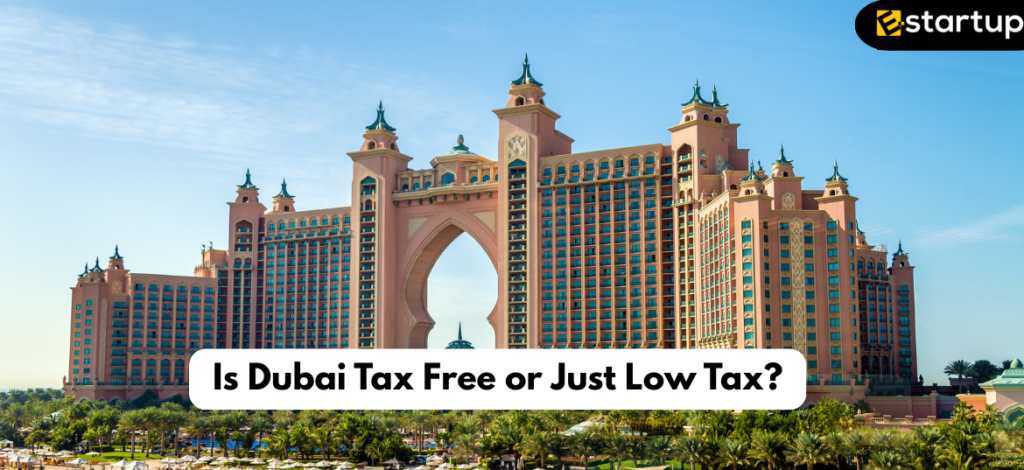
Is Dubai Tax Free or Just Low Tax?
Over the decades, Dubai has been promoted as a tax-free , a place where businessmen, investors, and professionals could make and accumulate money without the taxation issue. However, as the UAE economy grows and becomes compatible with the international standards, a crucial question should be addressed:
Is Dubai tax free or just a low tax jurisdiction? Let’s break down the reality:
Why Dubai Earned the Tax-Free Reputation
The tax-free reputation of Dubai was not established overnight. Indeed, for quite some time, it was the case that there was no income tax, no capital gains tax, and no corporate tax in the UAE. This obviously presented a highly attractive proposition for:
- Foreign entrepreneurs
- Global investors
- High-earning professionals
- Multinational companies
Unlike Western economies, the UAE relied on oil revenues, trade, tourism, and government fees rather than direct taxation. This allowed individuals and companies to operate with minimal fiscal burdens.
Personal Income Tax
If you are an individual employee, freelancer, or professional, Dubai still remains effectively tax free.
What you don’t pay:
- Personal income tax
- Salary tax
- Capital gains tax (for individuals)
- Wealth or inheritance tax
Whether you earn AED 10,000 or AED 1 million per month, the UAE government does not take a percentage of your salary.
This is one of Dubai’s biggest advantages, especially for high-income expatriates from countries like India, the UK, or Europe.
Corporate Tax
In June 2023, the UAE introduced Federal Corporate Tax
Corporate Tax Rates in the UAE:
- 0% on taxable profits up to AED 375,000
- 9% on profits above AED 375,000
Compared globally, this is still extremely low.
Who Must Pay Corporate Tax?
- Mainland companies
- Free zone companies not qualifying for exemptions
- Large international groups operating in the UAE
Who Can Still Pay 0%?
- Qualifying Free Zone Persons (QFZP) earning qualifying income
- Small businesses below the threshold
- Certain government and regulated entities
So, while Dubai is no longer corporate tax free for everyone, it remains one of the lowest-tax business hubs globally.
VAT
Since 2018, the UAE has applied Value Added Tax (VAT) at 5%.
Key VAT Points:
- Applies to most goods and services
- Businesses must register if turnover exceeds AED 375,000
- Essential sectors like education and healthcare may be zero-rated or exempt
At just 5%, UAE VAT is among the lowest in the world, especially compared to Europe’s 18–25% VAT rates.
Customs Duties & Other Fees
Dubai also applies:
- 5% customs duty on most imported goods
- Excise tax on tobacco, sugary drinks, and energy drinks
- Government fees for licenses, visas, and renewals
These are usage-based taxes, not income-based, meaning you pay only when you consume or import.
Global Tax Compliance
Dubai is no longer a tax haven in the traditional sense. The UAE complies with:
- OECD Base Erosion and Profit Shifting (BEPS) rules
- Economic Substance Regulations (ESR)
- Global minimum tax (Pillar Two) for large multinationals
This has increased transparency while maintaining a business-friendly environment.
Conclusion
Dubai’s evolution from a tax-free economy to a low-tax, transparent global business hub has actually strengthened its credibility. Instead of driving investors away, the changes have attracted serious businesses seeking stability, predictability, and international acceptance.
If you are planning to work, invest, or start a business in Dubai, understanding the real tax structure is essential and often far more favorable than anywhere else in the world.
Make Dubai work for you legally and tax-efficiently.
Get started with E-startup today !